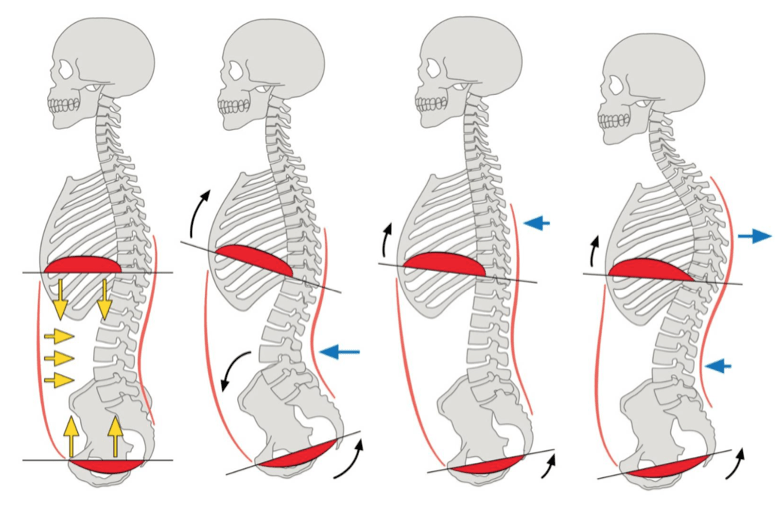
Have you ever caught yourself holding your breath? What’s going on there? Breathing is controlled by the autonomic (automatic) part of the nervous system. Essentially, we don’t have to think about taking a deep breath. Breathing is necessary for human life, and dysfunctional forms might be implicated in a number of problems from non-specific symptoms of dizziness and anxiety to physiologic issues like asthma. Proper breathing mechanics are part of optimal health. When was the last time your doctor evaluated that?
The diaphragm is the major muscle involved in the breathing mechanism, and is controlled by the phrenic nerve coming from the upper neck region (Can neck issues affect breathing? Yes!). Upon inspiration (breathing in) the diaphragm contracts, providing more room for air to enter the lungs, and with expiration (breathing out) the opposite occurs. Our spinal posture and the front side (beer belly anyone??) can drastically affect the efficiency of the system (diagram above). The consequences of a poor mechanism can lead to dysfunctional breathing patterns. Similarly, the heart and lungs are closely interrelated; if breathing is irregular, changes in oxygenation and blood flow occur.
So, what does that mean? Well, if the body senses decreased oxygen levels and blood flow, this signals the autonomic nervous system to kick into gear. The parasympathetic regulation (rest and digest) gets turned down in favor of the sympathetic (flight or fight). Now your body is in a constant state of vigilance, leading to sympathetically driven symptoms: anxiety, dizziness, numbness sensation, shortness of breath and an overall decrease in quality of life.
Two tools I utilize regularly are working on good diaphragmatic breathing and mouth taping to help with disordered breathing while asleep. Watch the following video to gain more insight: https://www.youtube.com/watch?v=tDbiGjiOvZg
 Elemental Health